For questions about financial assistance,
call 1-844-DUPIXENT, option 1 or
click to learn more
- Q:
- A:
Being diagnosed with EoE means you’re already on the right path
The next step is working with your doctor to create a treatment plan that works for you.
It can be helpful to learn from others who have had similar experiences with EoE. See how patients and caregivers like Megan partnered with their doctors to find a treatment plan that works for them.

I think taking the time to really understand and come up with a game plan with your provider that you’re comfortable with will really give you a lot of confidence.
DON’T BE AFRAID TO STICK UP FOR YOURSELF, ASK QUESTIONS, AND BRING UP ANY CONCERNS YOU MAY HAVE.

Megan
Caregiver
of a child
with EoE
of a child
with EoE
- Q:
- A:
Getting answers can be a challenging process, but you’re on the
right track
EoE is a chronic, progressive condition that can cause pain or difficulty swallowing.
If you suspect you have EoE, it's important to seek professional help without delay because it can cause progressive damage in the esophagus if left untreated. That’s why it’s so important to talk to your doctor about getting a diagnosis.
To learn more about EoE, visit What Is EoE? or explore the Patient Brochure.
- Q:
- A:
It’s a great sign that EoE doesn’t seem to affect swallowing food
Difficulty swallowing is one of the most common symptoms of EoE, and can affect how you approach eating.
Even if EoE doesn’t have an impact on how you swallow food, underlying inflammation may still be doing damage.
An endoscopy with biopsy is the most accurate way to know if your EoE is under control. Your doctor can measure your eosinophil numbers and can help monitor any EoE progression behind the scenes.
- Q:
- A:
Feeling uncertain about what
foods you can swallow is common with EoE
Communicating your concerns about swallowing when eating can help your doctor understand your specific set of symptoms.
Meal time with EoE can feel unpredictable. Difficulty swallowing, getting food stuck in the esophagus, and chest pain/heartburn even after taking proton pump inhibitors (PPIs) are common symptoms of EoE and can affect how you approach eating.
Symptoms like these are important to discuss with your doctor!

IF YOU FEEL FOOD GETTING STUCK ON THE WAY DOWN, YOU NEED TO TALK TO YOUR DOCTOR.

Joshua
B. Wechsler,
B. Wechsler,
MD, MSCI
Sponsored by Sanofi
and Regeneron
Sponsored by Sanofi
and Regeneron
- Q:
- A:
Avoiding certain foods can be one of the
hardest challenges of dealing with EoE
Communicating the ways EoE affects swallowing when eating can help your doctor understand your specific set of symptoms.
Managing symptoms during meals can be a constant challenge. It’s a sign that your EoE is uncontrolled.
Visit Why DUPIXENT? and How DUPIXENT Works to learn more.
I remember being at camp. I was eating a peanut butter and jelly sandwich and it felt like it got stuck in my esophagus.

I had trouble getting it down. I didn’t think it was that abnormal, so I really didn’t discuss it with people.

Matt
DUPIXENT Patient
Ambassador
Ambassador
- Q:
- A:
That’s great if your current treatment plan is working for you
Continue to work with your doctor to maintain a treatment plan that is right for you.
Sign up to stay in the loop on upcoming webinars and events and get the latest stories from other EoE patients.
Sign up now for DUPIXENT emails and resources.
- Q:
- A:
It’s always a good idea to research and discuss additional options with your doctor
If your EoE is uncontrolled, it may be time to talk to your doctor about other options.
EoE is a chronic, progressive condition. Coping strategies such as cutting food into small pieces, chewing excessively, and washing down food with fluids, and procedures like esophageal dilation don't treat the underlying causes of EoE. It's important to choose a treatment that can target an underlying cause of EoE to help control symptoms.
It’s important to keep track of your symptoms.
It may also be helpful to hear from other patients who have experienced living with EoE.

- Q:
- A:
If you’re feeling overwhelmed, it’s time to get some 1:1 time with your doctor
If you're experiencing any kind of symptoms, that's a sign that your EoE is uncontrolled.
Consider asking your doctor these key questions:
- What are my eosinophil numbers?
- What did my last endoscopy show?
- Are there other treatment options, such as DUPIXENT, that could be an option for me?
If you're experiencing any kind of symptoms, that's a sign that your EoE is uncontrolled.
Consider asking your doctor these key questions:
- What are my eosinophil numbers?
- What did my last endoscopy show?
- Are there other treatment options, such as DUPIXENT, that could be an option for me?
DID YOU KNOW?
Eosinophil numbers are a key measurement used in EoE diagnosis and management. Eosinophils are a type of white blood cell that are not normally found in the esophagus. In EoE, eosinophils build up in the lining of the esophagus and cause inflammation. This inflammation can lead to difficulty swallowing, food getting stuck, and chest pain/heartburn even after taking proton pump inhibitors (PPIs).
To get the most out of your conversation, be prepared with any additional questions you may have. Write them down ahead of time and have the results from your symptom tracker handy.
- Q:
- A:
You and your doctor chose Dupixent (dupilumab)
Even more good news: There are resources available to help throughout your DUPIXENT treatment journey.
Start by enrolling in DUPIXENT MyWay® for answers to your treatment and insurance questions, along with a dedicated support team to help you get started and stay on track with your prescribed treatment plan.
There are also resources to help you and your loved ones with the injection process, like an injection support hub, information on traveling with DUPIXENT, and a child activity guide.
- Q:
- A:
This conversation kit is a great next step toward taking control of your treatment plan
There are plenty of tips and tools to help you get started.
Here’s how you can make the most of your next appointment:
- Check in online ahead of time
- Share any documents, tests, and lists of previous medications
- Have this conversation kit handy so you can communicate any results and questions to paint a clear picture of your condition
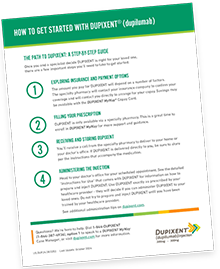
If you and your doctor decide that DUPIXENT is right for you, be sure to bookmark the How to Get Started Guide, which includes step-by-step instructions on everything from understanding insurance coverage to administering your injections.
- Q:
- A:
You’ve come to the right place to learn more about DUPIXENT (dupilumab)
Did you know it proactively treats EoE?
DUPIXENT is the first and only FDA-approved treatment of its kind for EoE. It is not a steroid or an immunosuppressant. Instead, it’s an injectable medication that targets a key source of inflammation. It proactively treats EoE so you can get ahead of symptoms.
Here are some questions you can ask your doctor about DUPIXENT:
- How does DUPIXENT work? How is it different?
- Have you used DUPIXENT with other patients?
- How is DUPIXENT given?
- How effective is DUPIXENT?
Here are some questions you can ask your doctor about DUPIXENT:
- How does DUPIXENT work? How is it different?
- Have you used DUPIXENT with other patients?
- How is DUPIXENT given?
- How effective is DUPIXENT?
- Q:
- A:
Support from your Gastroenterology team can be a great start
It’s important to have the right specialist on your team.
Take the time to hear real patients and a GI doctor discuss DUPIXENT. You may find it helpful as you set your own treatment goals and continue to build your support team.

- Q:
- A:
Support from a medical provider is a great start
See how a Gastroenterologist (GI doctor) can help round out your team. While other specialists like an Allergist can prescribe DUPIXENT, finding a GI doctor is an important part of finding the right treatment plan.
A GI doctor can perform an upper endoscopy to visualize your esophagus and collect biopsies. This can diagnose EoE and monitor your eosinophil numbers. So, finding a GI doctor is also an important part of finding the right treatment plan.
- Q:
- A:
Support is out there
Finding the right team is important to help control your EoE.
Without the right treatment plan, your EoE can continue to worsen and even cause further damage in the esophagus. Only a Gastroenterologist (GI doctor) can help you get diagnosed and track disease progression. Specialists (GIs, Allergists, and GI/Allergy nurse practitioners/physician assistants) can all help manage EoE and prescribe specialty EoE medications like DUPIXENT.
Here are some questions to ask them at your first appointment:
- How many patients with EoE have you treated within the last year?
- Can you refer me to a GI doctor who can perform an endoscopy with biopsy to determine if my EoE is under control?
Let’s get ready for
your next doctor visit
Watch this candid conversation with real patients and caregivers to learn strategies for making the most out of your
doctor visit.


Sign Up Today
Enroll now to receive emails and
resources designed to help, wherever
you are on your treatment journey.